

Remember there was once I posted the issue on eliminating the usage of polystyrene dining box in XMUM. To further study the perspective of Xiamen University Malaysia (XMUM) students toward recycling, I have conducted a survey through social media. The survey is created by using Survey Monkey free online service.
One of the reasons I choose social media as the platform to disseminate my survey is that it can reach more students in a short time. Besides, the time consumes for conducting this survey is less than direct distribution of printed version. Not to mention the cost of survey distribution through social media is zero.
First and foremost, I have come out with 9 questions to examine the behaviours and attitudes of XMUM students towards the issue of recycling. Overall, there are 41 effective students who replied the survey.
Speaking of the creation of questions, I first ask a question in the survey to separate the participants into two groups – students who support recycling and do not support recycling. Then, I further examine their daily recycling habits. Later on, I also request the students to rank the likeliness of doing recycling in future and to give their reasons of consider recycling as good or bad. In the questions, I mix up open-ended and close-ended questions for further elaboration.
Let’s see the result!
Q1
Q2.
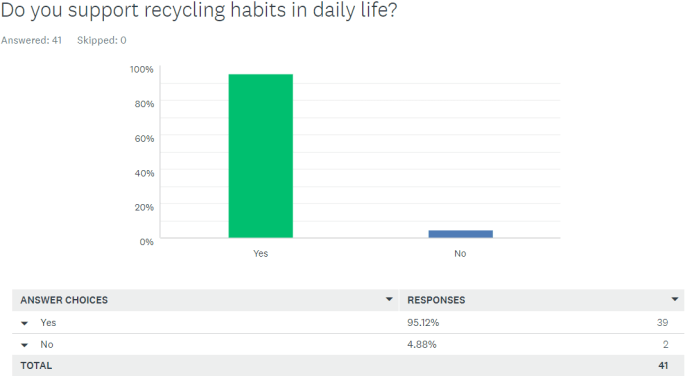
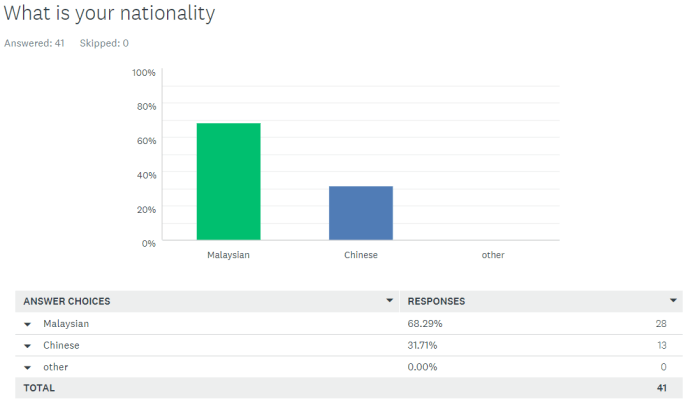
Now, there are 28 Malaysian students and 13 Chinese students participated in the survey. The result of survey shows that only 2 out of 41 students who did not support recycling habits in daily life. (Q4) The reasons given by the two students for not supporting daily recycling are:
- “Does not have regular time and date to practice recycling.”
- “Recycling is troublesome.”
- “Recycling is a bit inconvenient for daily basis.”
- “Lazy to do recycling.”
On the other hand, (Q3) the students who support recycling habits in daily life are because of the reasons:
- “Help to preserve environment.”
- “Prevent is better than cure.”
- “Avoid disaster like global warming.”
- “Reduces waste.”
- “Save energy.”
- “Like making handicrafts from recycle materials.”
- “Responsibility.”
So far, I can see that XMUM students have a high awareness towards recycling. The minority students who did not support recycling are due to their personal problem.
Q5.
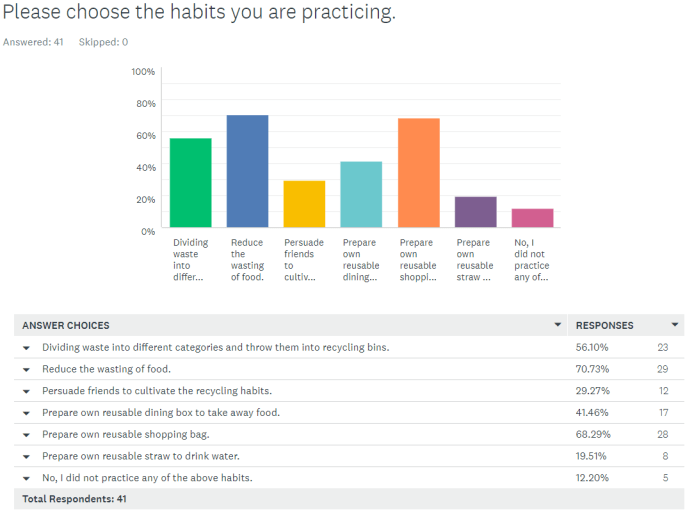
To examine the recycling habits practiced by the participants, there are seven choices provided include one which deny the practicing of any habits from the six choices. The participants can choose more than one habits they practice. The most chosen recycling habit practiced by the XMUM students is reducing the action of wasting food which chose by 29 students. While only 8 students who prepare their own reusable straw to drink water. The remaining options are as follows:
- Prepare own reusable shopping bag, 28 students chose.
- Dividing waste into different categories and throw them to recycle bins, 23 students chose.
- Prepare own reusable dining box to take away food, 17 students chose.
- Persuade friends to cultivate the recycling habits, 12 students chose.
The number of students who prepare own shopping bag is higher than the number of students who throw rubbish into recycle bins because there is no recycle bins in the campus. This is just an assumption that has high possibility to be the reason since XMUM did not provide recycle bins unless the Community Service held any activities.
In addition, there are 5 students did not practice any of the mentioned recycling habits. This shows that there are 3 students did not take actions even though they support recycling. Another possibility is they do the recycling habits that did not list in the options. However, they also did not mention the other habits in the comment section. There is one comment from a student who also practices other recycling habits, written: “I won’t get the plastic bag from cashier if I can take my stuff with hands.”
Q6.
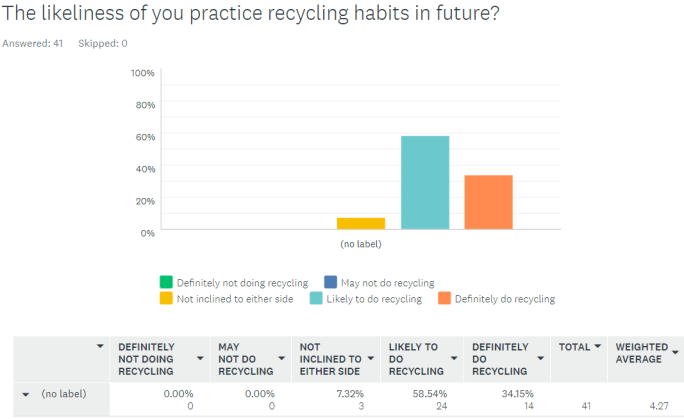
Furthermore, the likeliness of practice recycling habits in future is to study whether the participants will change their perspective towards recycling. The result shows that 14 XMUM students have determination to continue recycling efforts in future. Whereas most of the participants, 24 students in accurate, are likely to do recycling. Three students are not sure to practice recycling or not so they decide to stand in the middle point. At current stage, I notice that XMUM students are inclined to agree with the implement of recycling.
Q7.
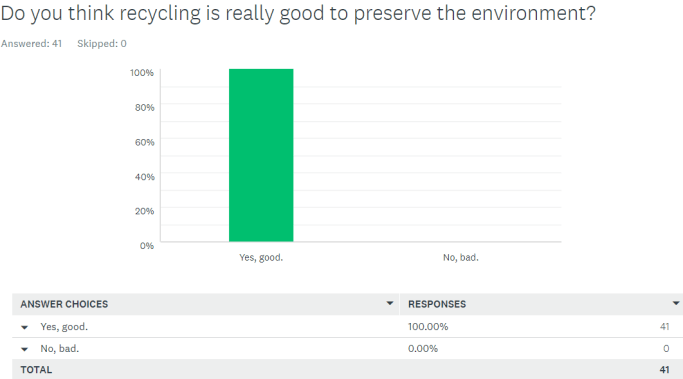
At last, all students agree that recycling is good for the preservation of environment. (Q8) The reasons given:
- “Easy to process rubbish.”
- “Keep environmental clean.”
- “As a sustainable development.”
Although the students chose to agree, (Q9) they have express their ideas on the disadvantages of recycling:
- “High cost for recycling process.”
- “Need more human resources and used up more resources to produce recycle bag.”
## In fact, one student even elaborates more through the following comment:
“In fact, reuse is better. Some recycling process is time and energy consuming. The energy consume is even higher than producing it (product) directly. Recycling is good for reduce speed of deforestation, reducing micro plastic in ocean and food chain. This is because rubbish has to be burn, buried. In reality we have almost insufficient place to remove those rubbish, so some are throw into river and to the ocean, finally to food chain. If we recycling it (rubbish) we can cut down the speed of production instead of reproduction, giving a cleaner earth”
Conclusion
In a nutshell, the recycling awareness of XMUM students is high. However, there are more ways to promote recycling in the university like the authority provides recycle bins in the campus. Moreover, recycling may be or may not be really helpful for the environment preservation. There is still some debate between the advantages and disadvantages of recycling.
Thank you for reading, please leave a comment if you have anything to share.
*The cover image is taken from Cantoga.
*The statistics of the answers are screen shot from the created survey.

